


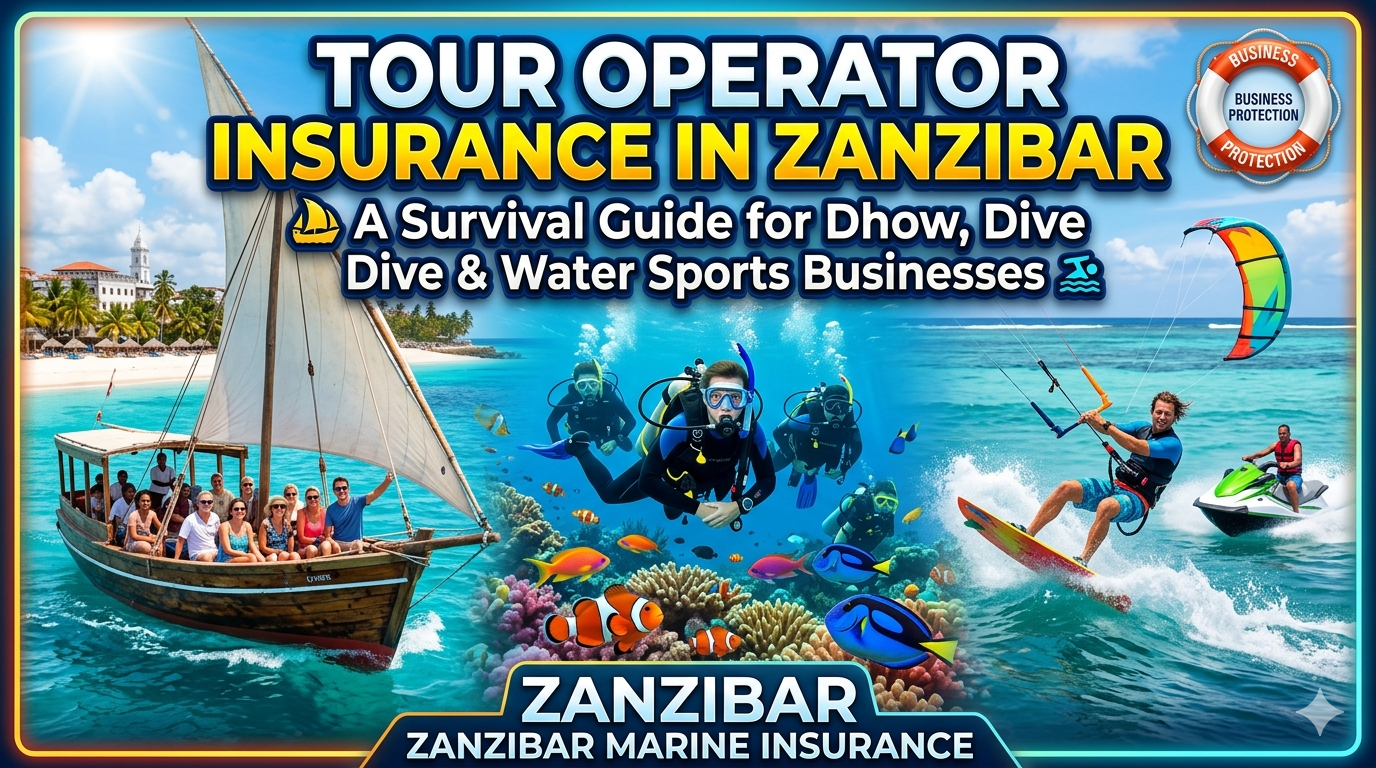
 Zanzibar receives over 700,000 international tourists every year, and a large share of them spend at least one day on a dhow cruise, snorkelling trip, kitesurfing lesson, or guided dive at Mnemba Atoll. Behind those experiences sits a fragmented ecosystem of small operators — most of them family businesses or one-boat outfits run by entrepreneurs who learned the trade from a father, an uncle, or a friend.
Here is the uncomfortable truth that nobody likes to talk about over chai at the captain’s room: the overwhelming majority of these operators are uninsured, underinsured, or carry only the minimum third-party cover required to register the boat. One rough day at sea can end fifteen years of building a business.
This guide is for the dhow captains in Nungwi, the dive masters in Kendwa, the kitesurf instructors in Paje, the snorkel guides in Kizimkazi, and the boutique tour agencies in Stone Town who book all of them. If you run any of these operations, you are taking on risks that most insurance products in Tanzania are not designed for. Understanding what tour operator cover actually does — and what it does not do — is the difference between a small claim and a closed business.
Why Tour Operators Sit in a Risk Category of Their Own
A regular marine insurance policy covers your vessel. A motor policy covers your transfer van. A fire policy covers your office. None of these were built for what a tour operator actually does, which is take responsibility for the safety, comfort, and sometimes the lives of paying guests in environments that change by the hour.
A typical day for a dhow operator might involve a boat, a small skiff, six tourists from four countries, two staff members, drinking water, snorkel gear, a barbecue lunch, and a sunset return through choppy waters. Each of those elements carries its own exposure. The tourist who slips on the deck is a different claim from the tourist whose ₹2 lakh underwater camera disappears off Mnemba. The engine that fails twelve nautical miles offshore is a different claim from the food poisoning case that hits four guests after lunch.
Tour operator insurance exists precisely because these scenarios cut across the standard product categories. It bundles public liability, equipment cover, third-party injury, and certain operational losses into a single policy designed for service-led businesses.
The Six Risks Most Small Operators Underestimate
1. Tourist injury during the activity. This is the single largest source of claims globally in adventure tourism, and Zanzibar is no exception. A guest steps on a sea urchin during a snorkel stop and develops a severe infection. A kitesurfer crashes into a swimmer. A diver surfaces too fast and develops decompression sickness. In every one of these cases, the operator can be held liable — and modern tourists from Europe, North America, and India increasingly pursue claims even after returning home.
2. Drowning or near-drowning incidents. A single fatal incident can trigger criminal proceedings under Tanzanian law and civil claims under the tourist’s home jurisdiction. Operators have lost their licences, their boats, and their personal assets over a single afternoon.
3. Equipment loss and theft. Dive gear, kite equipment, fishing tackle, and underwater cameras represent a significant share of an operator’s working capital. Theft from beach storage and loss during operations is common, and most operators self-insure through painful experience.
4. Weather cancellation and refund obligations. The long rains in April and May, sudden squalls during the monsoon transition, and cyclone-adjacent weather systems force cancellations every season. Without business interruption cover, the operator absorbs the entire loss including pre-paid food, fuel, and staff wages.
5. Vessel damage and mechanical failure. Dhows, RIBs, dive boats, and tender vessels operate in saltwater conditions that destroy engines, electronics, and hulls faster than most operators budget for. A blown outboard at sea is both a safety incident and a repair bill.
6. Legal action from foreign tourists. This is the risk that ends businesses. A guest from London or Mumbai who suffers a serious injury will not necessarily sue in Tanzania. They will often pursue claims through travel insurance subrogation, through agencies in their home country, or directly through international counsel. Without professional liability cover, the operator faces these claims personally.
What Tour Operator Insurance Actually Covers
A well-structured tour operator policy from a Tanzanian insurer like Zanzibar Insurance Corporation typically addresses several distinct cover lines under one umbrella.
Public liability is the foundation. It responds to third-party claims for bodily injury or property damage caused by the operator’s activities. This is the cover that pays the tourist who breaks an ankle stepping off your dhow, or the resort whose jetty is damaged when your boat drifts in a storm.
Marine hull and equipment cover protects the vessel and the gear. This sits alongside or inside the tour operator policy depending on how it is structured. For dhow owners and dive operators, this is often the largest single component of the premium because the assets at risk are substantial.
Loss of licence and business interruption addresses the income lost when an incident temporarily shuts down operations. After a serious accident, regulators may suspend the operating licence pending investigation. For a one-boat operator, three months without revenue can mean permanent closure.
Personal accident for staff and crew is critical because traditional crew members are often uninsured outside their employment. A captain injured during work has no fallback. A good tour operator policy includes named-crew personal accident cover.
Third-party legal defence funds the lawyer when a foreign tourist initiates legal action. This is often more valuable than the claim payout itself, because cross-border litigation costs alone can exceed what most small operators have in working capital.
Building the Business Side: Brand, Bookings, and the Digital Reality
Insurance is only one layer of operational maturity. The operators who survive long-term in Zanzibar are also the ones who treat the business side with the same care they bring to the boat.
The first decision most new tour operators face is what to call the business. Names like “Spice Island Adventures” or “Blue Dhow Tours” feel obvious, but the moment you check trademark databases or hotel booking referral lists, you discover dozens of nearly identical names competing for the same Google searches. A useful starting exercise is to run brainstormed names through an AI name generator to surface variations that combine Swahili words, marine themes, and your specific niche — something distinct enough that returning guests can find you again and that does not get confused with an unrelated operator’s poor review.
Once the business is named and registered, the second operational headache appears almost immediately: managing incoming booking inquiries. Tour operators who list on TripAdvisor, GetYourGuide, Viator, or even their own Instagram quickly notice that a large share of inquiry emails are not real bookings. Some are price-shopping with no intent to book, but a meaningful percentage are throwaway addresses created by scrapers, competitors checking your pricing, or bots collecting tour itineraries.
This becomes a real cost when an operator builds a follow-up email sequence for inquiries and discovers that thirty to forty percent of the contact list never opens anything because the addresses were never real. Filtering disposable email addresses at the inquiry stage helps small operators focus their follow-up time on guests who are actually planning to travel — and protects their domain reputation from the bounce rates that come with chasing dead addresses.
TIRA Compliance and What Regulators Actually Check
The Tanzania Insurance Regulatory Authority sets the minimum insurance requirements for licensed tour operators, and these are non-negotiable for any business that wants to renew its operating permit. Third-party motor cover for transfer vehicles, basic marine cover for vessels carrying paying passengers, and minimum public liability are all checked during licence renewal.
Where many operators stumble is on the gap between the minimum cover and the actual risk. A policy that satisfies TIRA for licensing purposes may pay out only a fraction of what a serious foreign injury claim demands. Reviewing the policy schedule with the broker or insurer once a year — and adjusting the sums insured as the business grows — is one of the cheapest forms of protection available.
For operators expanding beyond a single boat or single activity, multi-cover bundled policies become more economical than buying lines separately. This is where established insurers with branch networks across the islands have an advantage: a single point of contact in Stone Town or Pemba can structure marine, public liability, and personal accident cover under one schedule, with one renewal date.
The Bottom Line for Zanzibar Operators
The tour operators who treat insurance as a tax disappear from the industry every few years after a bad season. The operators who treat it as part of operational risk management are still running boats a decade later. The premium difference between minimum cover and proper cover is rarely more than a few hundred thousand shillings per year for a small operator, less than the cost of one repair after a grounding incident.
If you run a dhow, a dive shop, a kitesurf school, or a boutique tour agency in Zanzibar, the right question is not whether you can afford tour operator insurance. The right question is what one bad incident would cost you without it, and whether you would still have a business twelve months later. Zanzibar Insurance Corporation works with operators across all eleven branch regions and can structure tour operator cover that matches the actual shape of your business — from single-boat dhow operations to multi-activity adventure agencies.
Get in touch through any ZIC branch, or send your details to the head office in Mlandege. The cheapest claim is the one you never have to make. The most expensive lesson is the one you learn after the accident.