


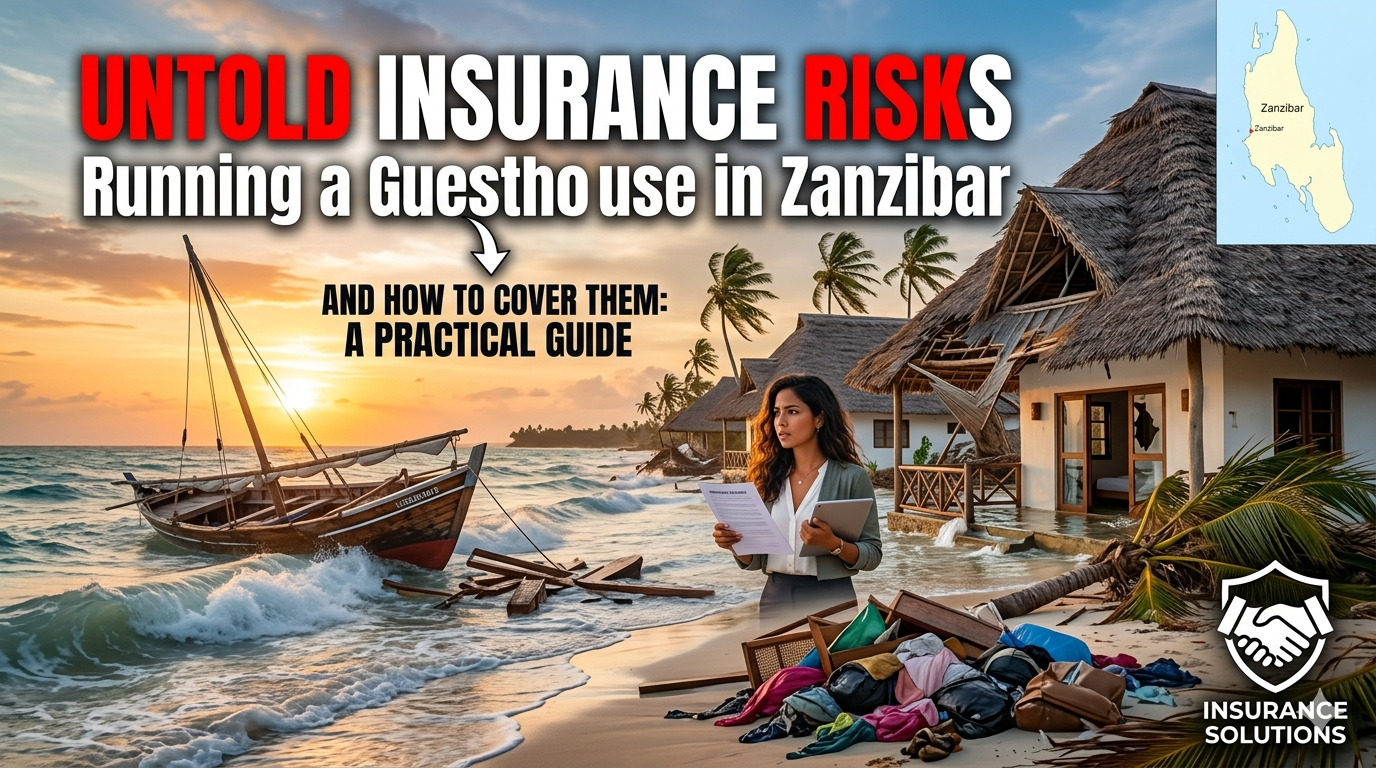
 Walk through Stone Town in the late afternoon and you will pass dozens of small guesthouses tucked into coral-stone buildings, some four hundred years old. Drive up the east coast to Paje, Jambiani, or Bweju and the same story repeats in a different form: family-run beach guesthouses, six rooms over a restaurant, a courtyard with bougainvillea, a Wi-Fi router taped to a wall. Zanzibar has more than 1,200 small accommodation businesses outside the big resort brands, and the number grows every year as Airbnb hosts and boutique operators enter the market.
These are real businesses generating real income. A six-room guesthouse on the east coast can earn a comfortable living for a family. A converted merchant house in Stone Town with eight rooms and a rooftop restaurant can do considerably better. And yet the same conversation plays out across the islands when an insurance broker walks in: the owner has fire cover on the building, sometimes, and nothing else.
The assumption that small property equals small risk is the most expensive belief in the hospitality business. This is a guide for the owners of small guesthouses, boutique lodges, and self-managed Airbnb properties across Unguja and Pemba — written from the perspective of what actually goes wrong, not what an insurance brochure says might go wrong.
The Seven Risks Sleeping Inside Every Guesthouse
1. Fire, especially in older Stone Town buildings. The coral-stone and mangrove-timber construction that gives Stone Town its UNESCO heritage status is also a fire engineer’s worst nightmare. Old electrical wiring, gas cylinders in narrow kitchens, candle lighting during power cuts, and shared walls between buildings mean that a fire in one property quickly becomes a fire in three. A claim that involves damage to a neighbour’s property turns from a property loss into a liability case overnight.
2. Theft, with two distinct exposures. The first is theft of the owner’s cash and stock — petty cash from the reception drawer, kitchen inventory, electronics, the contents of the safe. The second is theft of guest belongings, which is the more dangerous of the two because it creates a guest grievance, a TripAdvisor incident, and often a small-claims action under tourism law.
3. Guest injury on the property. Slippery rooftop tiles after rain, broken stair railings, swimming pool incidents, electric shock from old fittings, falls from beds without guard rails for elderly guests. Each of these has produced claims in Tanzania, and most guesthouse owners have no public liability cover to respond to them.
4. Food poisoning incidents. The moment a guesthouse serves food — breakfast, lunch, dinner, even just complimentary fruit — the property becomes legally responsible for what guests consume. A bad batch of seafood, undercooked chicken, or contaminated water can affect multiple guests at once, and modern travellers document every detail in writing.
5. Property damage from weather and natural events. The long rains, occasional cyclone-edge weather systems, and rising sea levels along the east coast cause real structural damage every year. Roof collapses, water ingress, salt corrosion, and storm surges have shut down guesthouses for entire seasons.
6. Business interruption after an incident. Even a recoverable fire or flood can mean three to six months of zero revenue while repairs and inspections proceed. For a guesthouse that funds the family’s living costs from monthly bookings, that gap is rarely survivable without business interruption cover.
7. Disputes that escalate into legal action. Refund disputes over cancelled bookings, complaints about misrepresented amenities, allegations of theft from rooms, and disagreements with staff have all ended up in front of magistrates and regulatory tribunals. Legal defence costs alone can exceed a small guesthouse’s monthly profit.
Why “Small Property” Does Not Mean “Small Risk”
The instinct that a small property carries small risk is built on Tanzanian reasoning. In a domestic context, a small business often deals with domestic customers, and the legal and financial consequences of an incident are proportional to local realities. A guesthouse is different. The guest who slips on your stairs is not your neighbour. They are a forty-year-old executive from Berlin or a honeymoon couple from Mumbai, and the consequences of an injury that ruins their trip are measured against their economic reality, not yours.
Several recent cases across East Africa have made this concrete. A guesthouse in Arusha faced a claim from a European tourist after a fall on uneven flooring, eventually settling for an amount that exceeded the property’s annual revenue. A small lodge on the Tanzanian coast was sued through a tourist’s travel insurer after a food poisoning incident affected a tour group. These cases do not always make the news, but every broker working in hospitality cover knows them by name.
The financial logic is straightforward. The cost of a basic fire-plus-liability policy for a six-room guesthouse runs from a few hundred thousand to just over a million shillings per year depending on the property value and cover limits. The cost of one uninsured liability case can be ten or twenty times that figure.
The Insurance Stack a Small Guesthouse Actually Needs
A properly structured insurance programme for a small guesthouse in Zanzibar typically includes four cover lines, sometimes bundled into a single policy and sometimes maintained separately depending on the insurer.
Fire insurance is the foundation, and most owners already have at least a basic version of this in place because mortgage lenders require it. The important question is whether the sum insured reflects the actual rebuild cost in today’s market — not the price you paid five years ago, and not the value on the original purchase deed. Old policies tend to under-insure dramatically, which means partial payout on a total loss.
Public liability cover is the line most owners skip and most need. It responds to claims from guests, visitors, staff, and third parties for injury or property damage caused by your operations. Cover limits should reflect the international nature of your guest base — a domestic-scale limit of five or ten million shillings is rarely adequate for foreign guest claims.
Money insurance protects cash on premises and in transit. Guesthouses that handle reception payments, especially those without full card payment integration, accumulate cash overnight and during weekends. A money policy responds to theft, robbery, and accidental loss within agreed limits.
Business interruption cover is the difference between a claim that pays repair costs and a claim that keeps the business alive. It replaces lost gross profit during the period when the property cannot operate because of an insured event. For seasonal businesses, this is where survival is actually purchased.
Beyond these four, larger guesthouses with restaurants, swimming pools, and water sports rental should consider product liability and professional indemnity components depending on the activities offered.
Getting Found Online: The Business Side That Touches Insurance
Insurance is one half of operational maturity. The other half is making sure paying guests can find you in the first place — and that the brand you build is one you can defend.
The first hurdle for new guesthouses is online discoverability. A new property might have a Facebook page, an Instagram account, and a listing on Booking.com, but no real website of its own. The cost of this becomes obvious within the first year: every booking platform takes fifteen to twenty percent commission, the property has no direct relationship with returning guests, and Google searches for “guesthouse in Stone Town” surface competitors instead. Building a simple website with proper search visibility — including generating an XML sitemap so Google can index every room page and rate sheet correctly — is one of the cheapest marketing investments a small property can make.
The second hurdle is the name itself. Zanzibar has dozens of guesthouses called some variation of “Spice”, “Ocean”, “Paradise”, “Coral”, or “Stone Town”. When a returning guest types your name into Google, they end up at someone else’s TripAdvisor page. Worse, when a bad review appears for a similarly named property, it can attach itself to yours by association. Before committing to a guesthouse name or rebranding an existing property, it is worth taking a few minutes to check how many similar business names already exist across the region — both to avoid confusion and to spot trademark conflicts before they become legal problems.
What Actually Happens at Claim Time
The difference between insurers becomes visible only at claim time. For small guesthouse owners across Zanzibar, the practical realities matter more than the policy wording. Can you walk into a branch on Pemba or in Stone Town and speak to someone the same week? Will the loss adjuster understand the building type, the seasonal revenue patterns, and the documentation that small properties realistically maintain? Will the claim process accommodate the fact that you probably do not have CCTV, professional accounting records going back five years, or itemised inventory lists?
These are the questions worth asking before you sign the policy, not after the fire. Insurers with established branch networks across the islands — Zanzibar Insurance Corporation among them, with eleven regional branches — are typically better equipped to handle the hospitality claims that come out of small properties because they have seen the cases before.
Closing Thought
Running a small guesthouse in Zanzibar is one of the most rewarding businesses on the islands. It is also one of the most exposed to the kinds of incidents that can be absorbed easily with the right cover and disastrously without it. The owners who treat insurance as an operational priority rather than a tax sleep better, sell their properties for better multiples when the time comes, and survive the bad seasons that the rest of the market does not.
If you own a guesthouse, a boutique lodge, or a self-managed accommodation property anywhere on Unguja or Pemba, sit down with an insurance broker or with ZIC directly and run through the four core cover lines. Make sure the sums insured reflect today’s costs, not last decade’s. And update the policy every year — because the property changes, the business grows, and the risks change with them.